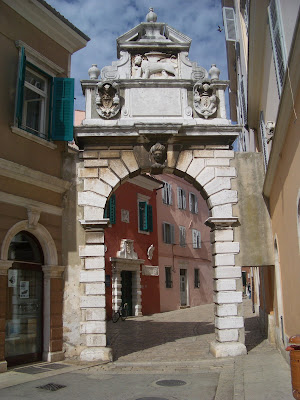
Ragusa (how Dubrovnik was offically called until 1909) is a really beautiful city and even if you plan to spend a holiday just on Croatian beaches...you shouldn’t leave the country without a daytrip to stunning Dubrovnik.
The prosperity of the city of Dubrovnik has always been based on maritime trade. In the Middle Ages, as the Republic of Ragusa, it became the only eastern Adriatic city-state to rival Venice.
Since 1979, the historic centre of Dubrovnik has been included in the UNESCO list of World Heritage Sites. Dubrovnik was founded in the first half of the 7th century by a group of refugees from Epidaurum (today's Cavtat a little town 20km south of Dubrovnik). T
 hey established their settlement at the island and named it Laus. Opposite of that location, at the foot of Srdj Hills, Slavs developed their own settlement under the name of Dubrovnik (dubrava means "oak forest"). The settlements were separated by a channel which was filled in 12th century, present Placa or Stradun, and since than the two settlements have been united. At that time the city walls started to be built as a protection from different enemies ( Arabs, Venetians etc.), who wanted to conquer Dubrovnik.
From its establishment in the 7th century, the town was under the protection of the Byzantine Empire. After the Crusades, Ragusa/Dubrovnik came under the sovereignty of Venice (1205–1358), and by the Peace Treaty of Zadar in 1358, it became part of the Hungaro-Croatian reign.
Between the 14th century and 1808 Ragusa ruled itself as a free state. The Republic had its peak in the 15th and 16th centuries, when its thalassocracy rivaled that of the Republic of Venice and other Italian maritime republics.
Crises of Mediterranean shipping and a catastrophic earthquake in 1667 ruined the well-being of the Republic. In 1806 the city surrendered to French forces.

Habsburg Empire gained these provinces after the 1815 Congress of Vienna and the new imperial authorities installed a bureaucratic administration, which retained the essential framework of the Italian-speaking system.
In 1849, Dubrovnik continued to lead Dalmatian cities in the struggle for unification:the federal system for Habsburg territories, inclusion of Dalmatia into united Croatia and Slavic brotherhood. With fall of Austria-Hungary in 1918, the city was incorporated into the new Kingdom of Serbs, Croats, and Slovenes (later the Kingdom of Yugoslavia).
In World War II, Dubrovnik became part of Independent State of Croatia, even if occupied by an Italian army first, and by a German army after September 1943. In October 1944 Tito's partisans entered Dubrovnik, that became consequently part of Communist Yugoslavia.
In 1991 Croatia and Slovenia, which at that time were republics within Socialist Federal Republic of Yugoslavia, declared their independence. Following Croatia's independence in 1991, Serbian-Montenegrin remains of Yugoslav People's Army (JNA) attacked the city.
The regime in Montenegro led by Momir Bulatovic which was installed and loyal to the Serbian government led by Slobodan Milosevic declared that Dubrovnik would not be permitted to remain in Croatia because they claimed that it was historically part of Montenegro.
 Following the end of the war, damage caused by shelling of the Old Town was repaired. Adhering to UNESCO guidelines, repairs were performed in the original style (for my opinion it was a little too much restored, it almost starts to look fake)
The city is full of restaurants that offers mediteranean cuisine. Although the locations is wonderful and sure a good place to chill off, the food is very much adapted to tourists tastes. (Usually the balkans cuisine is much more tasty than that!)
 On the sea oriented side of Dubrovnik there are some cute cafe-bars where you can enjoy a stunning panoramic view....
 A striking feature of Dubrovnik is its walls that run 2km around the city. The walls run from four to six metres thick on the landward side but are much thinner on the seaward side. The system of turrets and towers were intended to protect the vulnerable city but now make one of the most picturesque sights in the Adriatic.
 The patron saint of the city is Sveti Vlaho (Saint Blaise), whose statues are seen around the city. Dubrovnik's most beloved church is St Blaise's church, built in the 18th century in honor of Dubrovnik's patron saint. Dubrovnik's baroque Cathedral was built in the 18th century and houses an impressive Treasury with relics of Saint Blaise. The city's Dominican Monastery resembles a fortress on the outside but the interior contains an art museum and a Gothic-Romanesque church.
 George Bernard Shaw who visited the city in 1929 said: "If you want to see heaven on earth, come to Dubrovnik." This sentence is commonly used by tourist guides to describe the city.


.JPG)

.JPG)